Japan's False 9.9 Earthquake Alert: What Happened and Why Churches Prepare
On October 16th, phones and sirens across Japan warned of a magnitude 9.9 earthquake. It was a false alarm, but it showed why preparing ahead matters.

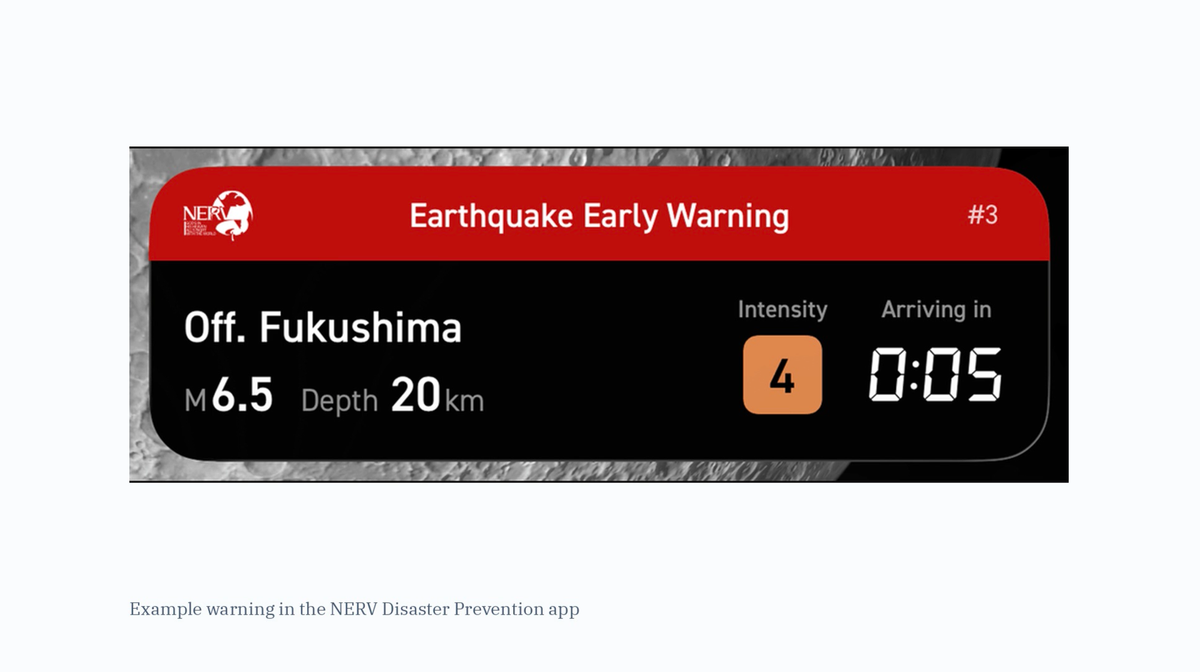
On Friday, October 16th, phones and sirens across much of Japan warned of a magnitude 9.9 earthquake. That would have been the largest earthquake ever recorded. It turned out to be a false earthquake alert, and thankfully we felt almost nothing here in Tokyo. But the alarm was real, its effects were real, and it reminded me why preparing ahead of time matters so much for families and for churches in Japan.
The Day Japan's Earthquake Alert Went Off
Pastor Ben and I were at his home talking about marriage and life. Our wives were out shopping at Costco. We were sitting at the dining table, in the middle of a conversation about a podcast, when we heard a familiar sound.
It wasn't just one noise. Both of our phones went off at full blast, and outside we could hear the neighborhood sirens. We both knew something was wrong.
In Japan, any time a large earthquake is detected you are alerted about it. Sometimes the alert comes just before the shaking begins, and sometimes it comes in the middle of it. These alerts bypass your phone's silent mode, so in a public place you hear a whole chorus of phones go off at once. In parts of Tokyo, the local sirens sound along with them.
Remembering a Real Shake in Edogawa
I had only heard our local siren once before, and I remembered clearly what it meant.
On August 23rd, the sirens in Edogawa went off and we felt one of the larger earthquakes I've experienced living in Tokyo. We went over to check on our son in his crib while it was shaking. Afterward, our apartment elevator was shut down for two days for a safety check. Our neighborhood rated that shaking as Shindo 4.
So when the city alarm went off at my friend's house, I was mentally prepared for a bigger shake.
How Japan's Shindo Scale Measures Earthquakes
One thing that confuses many foreigners in Japan is that the earthquake numbers you hear here usually aren't magnitude. Japan uses its own seismic intensity scale, called Shindo.
Magnitude measures the energy released at the source of an earthquake. Shindo measures how strongly the ground shakes where you are. The two measure different things, but with both, a higher number is bad news.
The JMA Seismic Intensity Scale ↗ runs from 0 to 7, with levels 5 and 6 each split into "lower" and "upper." To give a sense of the scale:
- Shindo 4: most people are startled, people walking feel the shaking, and most sleepers wake up. That was our August quake.
- Shindo 6 lower: it becomes hard to stay standing.
- Shindo 7: the highest rating. Unsecured furniture can be thrown through the air, and weaker concrete walls and buildings can collapse.
A False Earthquake Alert for a Magnitude 9.9
At about 12:40 p.m., the Japan Meteorological Agency (JMA) issued an emergency earthquake warning for a magnitude 9.9 quake near the Kuril Islands, with shaking of up to Shindo 7 forecast for Hokkaido and Tohoku. The warning reached a huge area, from Hokkaido down through the Kanto region, including Tokyo.
A magnitude 9.9 earthquake would have been bigger than anything ever measured. The largest earthquake on record ↗ was the magnitude 9.5 quake in Chile in 1960. Earthquake magnitude isn't a linear scale: each whole step means roughly 32 times more energy. Even the jump from 9.5 to 9.9 means about four times the energy of the largest earthquake ever recorded.
Clearly something was wrong, and any person looking at the number would have known it was impossible. The actual earthquake was a magnitude 6.9 near Russia's Kamchatka Peninsula, and the strongest shaking anywhere in Japan was Shindo 1, in Hakodate. The JMA withdrew the warning about eight minutes later and apologized at a press conference ↗. According to Metropolis ↗, the agency said a probable software processing error had applied a formula meant for domestic earthquakes to one centered far from Japan, and that this was the first public earthquake warning it has ever had to retract.
Praise God, it was a false alarm. Japan's earthquake system is robust and careful, it measures a huge number of data points, and it usually does an excellent job. This was one public example of a false positive, and the experts are already working to fix it.
A False Alarm Still Has Real Effects
Even so, the alert had real-world effects.
Think about everyone in a train station, a shopping center or an office who heard the alarms go off all at once, checked their phones, and read that a massive earthquake was coming. That can't be discounted. For a few minutes, many people believed a mega earthquake was about to hit.
The alert also stopped bullet trains. The Tokaido Shinkansen's earthquake protection system suspended service between Shin-Yokohama and Toyohashi for about 15 minutes ↗, and some trains were still running late that afternoon. Japan's train network is finely tuned and tightly scheduled, so delays ripple down the line. In the government, the Chief Cabinet Secretary postponed a parliamentary budget committee appearance ↗ to be briefed at the Prime Minister's Office. National leaders are rightly invested in keeping people safe.
Why Earthquake Preparedness Matters in Japan
Earthquakes are part of everyday life in Japan. False alarms are not. But every alert is a reminder that a big earthquake can happen at any time.
Schools, businesses, and everyone living here are encouraged to be prepared. We keep an emergency preparedness backpack in our house, and many people are asked to have one ready to grab on the way out the door. Ours holds emergency supplies like water and emergency rations.
People need to prepare because you never know when an earthquake will hit, and when a big one does, it can take a very long time for things to get back to normal. I've heard stories from people who lived through the March 11, 2011 earthquake, and things weren't normal even in Tokyo for many days.
How Churches in Japan Serve After Earthquakes
The good news is that churches in Japan are in a great place to serve during earthquakes. They have useful buildings with storage space, relationships with people in the neighborhood, and volunteers ready to help when it's needed. Many churches have been used as temporary shelters after large earthquakes.
In 2011, many churches stepped up as bridges between Christian resources and volunteers coming in from around the world and the needs springing up everywhere. Churches host and distribute aid from Christian organizations that give and serve in moments of crisis. They offered food, shelter, support and volunteers.
Churches also stayed for the long haul. Even after official public support ended, churches kept visiting people in temporary housing to encourage them, to share about Jesus, and to share the hope that comes with the gospel.
Preparing Churches Before the Next Earthquake
Japanese church leaders have pointed out that churches need to prepare before a crisis, so the plans and relationships are already in place to help well. Churches can offer buildings, resources, prayer, trust in the neighborhood, and an alternative to overburdened public services when a large-scale disaster happens. But that help is hampered if a church hasn't prepared beforehand.
In fact, one leader spoke about this just before the big alert went off. As a church, we need to be ready to care for people and to steward well the resources God has given us. Sometimes that means preparing now. We're growing in this.
We pray that no large-scale earthquake ever hits Tokyo or any of Japan's major cities. But earthquakes can happen here at any time, and we want to be ready to serve and to share the gospel in any season.